Christianity
Luke
“And, behold, thou shalt conceive in thy womb, and bring forth a son, and shalt call his name JESUS.”
Across these traditions, a divine messenger appears to a woman to announce a miraculous birth, often accompanied by instructions regarding the child's name and destiny. While the narrative structure of the encounter remains consistent, theological interpretations of the child's nature diverge significantly. In Christianity, the child is identified as the incarnate Son of God, whereas Islam emphasizes his prophetic role without divinity. Jewish accounts typically frame the birth within the context of covenantal deliverance or specific consecration rather than incarnation.
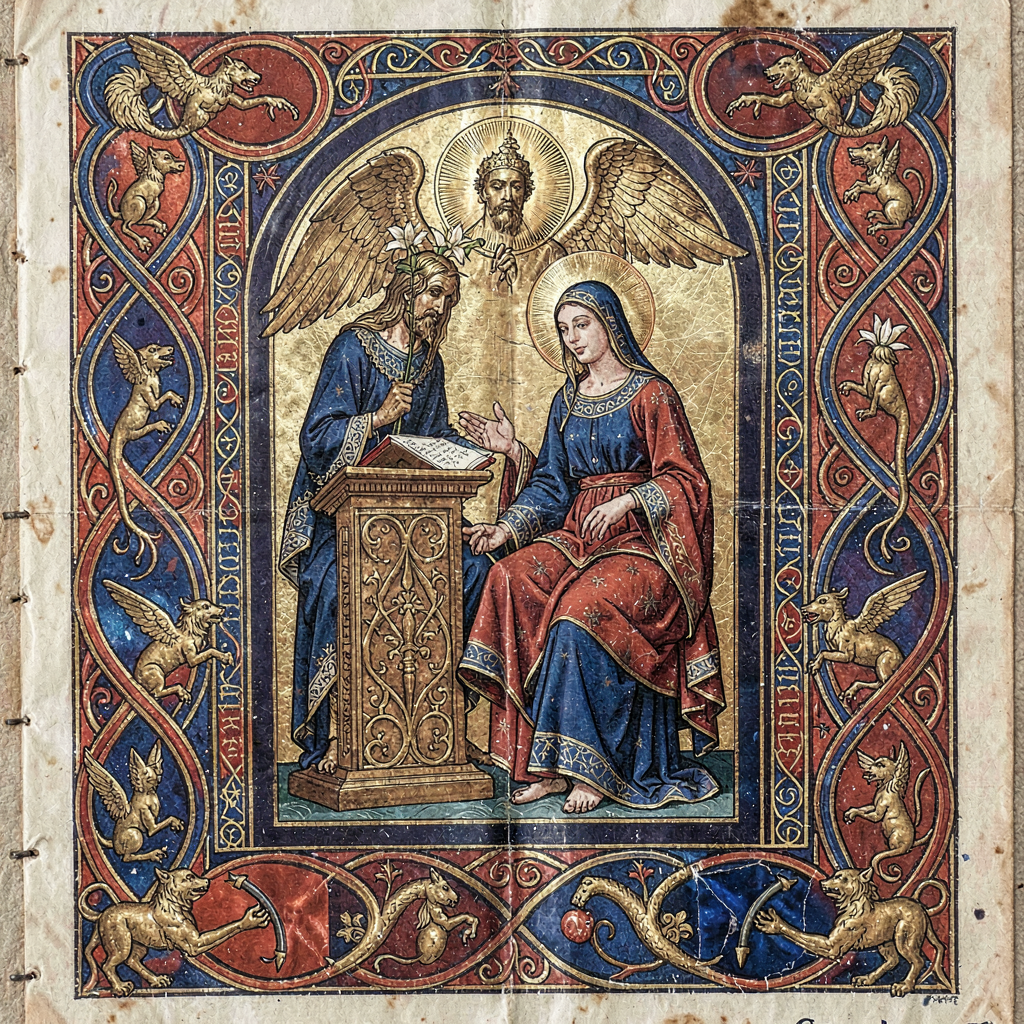
The motif of the divine annunciation serves as a critical nexus for examining how sacred traditions articulate the intersection of the human and the holy. In Luke 1:31, the angel Gabriel instructs Mary to name her son Jesus, framing the event as the incarnation of the divine Logos who will reign eternally. This narrative establishes a theology of divine sonship that defines Christian soteriology. Conversely, the Qur'anic account in Surah Maryam (19:19) presents a parallel encounter where the spirit declares, "I am only a messenger of thy Lord," bestowing a "faultless son" who remains strictly a servant and messenger. Here, the miraculous conception affirms God's absolute power while rigorously rejecting any notion of literal divinity or sonship. Similarly, in the Hebrew Bible, the angel's appearance to the barren woman in Judges 13:3 announces a birth destined for deliverance, yet the child is consecrated as a Nazirite rather than a divine being. While all three narratives share structural elements—the messenger, the miraculous conception, and the naming instruction—their theological divergences are profound. Christianity interprets the event as the entry of God into history; Islam views it as a supreme demonstration of prophetic mercy within strict monotheism; and Judaism frames it as a covenantal intervention for national liberation. These distinctions reveal how a shared narrative architecture supports vastly different understandings of the child's ultimate nature and destiny.
The announcement centers on the incarnation of the divine Logos, establishing the child as the Son of God who will reign eternally. This theological claim distinguishes the Christian narrative from prophetic traditions that deny divine sonship.
The spirit affirms the child is a servant and messenger of God, explicitly rejecting any notion of divinity or sonship in the literal sense. Islamic exegesis emphasizes the miraculous nature of the birth while maintaining strict monotheism.
The birth is framed as a miraculous intervention for deliverance or covenant fulfillment, with the child consecrated as a Nazirite rather than divine. The angelic message focuses on the child's role in liberating Israel from oppression.
Naming as a sacred act — the Tetragrammaton, the ninety-nine names of Allah, the syllable OM, the Tao that cannot be named. Every tradition makes the Name the place where speech meets the unspeakable.
The divine summons — every tradition turns on the moment a voice names a name and a life turns. Abram. Moses. Mary. Muhammad. Siddhartha.
She that beareth, she that hath compassion — every tradition gives the mother a place of unique honor, and remembers the cries of her son before all other prayer.
No one has written anything here yet. Some places to begin:
Sign in to join the discussion.