Judaism
Exodus
“The LORD is a man of war: the LORD is his name.”
The motif of the divine warrior depicts a deity engaging in cosmic or historical combat to establish order against forces of chaos or oppression. While the Hebrew Bible and the Rigveda present Yahweh and Indra respectively as active combatants who physically defeat chaotic monsters or enemies, the New Testament and the Bhagavad Gita reframe this violence through eschatological judgment and the metaphysical duty of righteous action. Scholars debate whether the shared Chaoskampf motif reflects deep cultural exchange across the ancient Near East and South Asia, or independent theological developments addressing the problem of evil and social disorder.
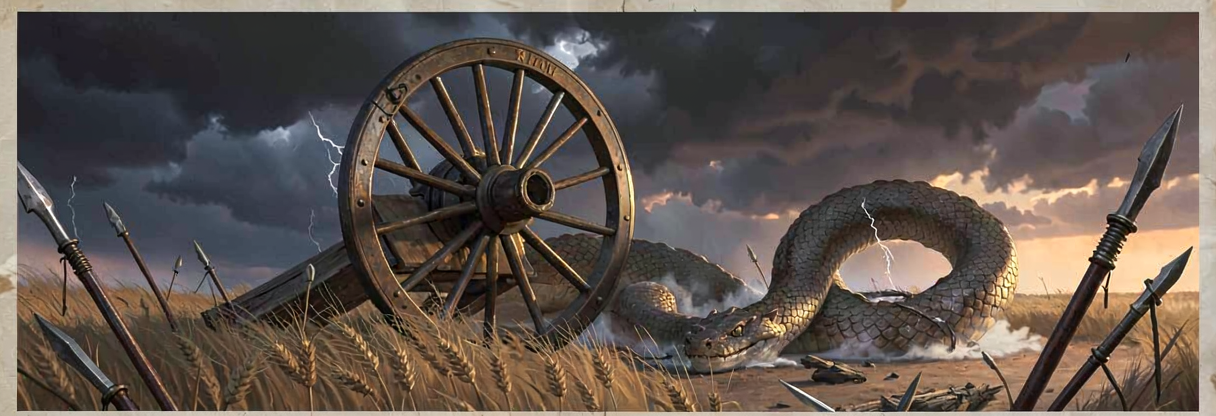
The divine warrior motif articulates a universal theological imperative: the intervention of a supreme deity to subdue chaos and establish cosmic or social order. In the Hebrew Bible, Yahweh is explicitly identified as a man of war, whose historical deliverance of Israel from Egypt in Exodus 15 demonstrates a communal focus where divine combat secures national identity. Similarly, the ancient Near Eastern Enuma Elish portrays Marduk’s defeat of Tiamat as a cosmogonic act, yet the Epic of Gilgamesh shifts agency toward human heroes relying on divine favor. In the Rigveda, Indra’s slaying of Vritra releases the waters, a mythic creation event distinct from the historical particularity of the Exodus narrative. However, later traditions profoundly reframe this violence. The Bhagavad Gita transforms the warrior archetype into a pedagogical tool; Krishna urges Arjuna to fight not for personal gain but as a duty to dharma, prioritizing metaphysical righteousness over physical conquest. Christianity further eschatologizes the motif; Revelation 19 depicts the Rider on the white horse whose victory stems from the word of God and the Lamb’s blood, synthesizing martial imagery with sacrificial suffering. While the ancient texts emphasize the deity’s direct physical dominance over monsters or armies, the New Testament and Gita internalize the conflict, suggesting that true order arises from spiritual fidelity and ethical action rather than mere martial supremacy. This evolution reflects a shared human struggle to reconcile divine power with the problem of evil.
Yahweh's warfare is often historical and communal, focused on the deliverance of Israel from political enemies rather than solely cosmic mythic combat. The 'Song of the Sea' celebrates a specific historical intervention where God drowns the Egyptian army, establishing the nation's identity.
In the Rigveda, Indra's slaying of Vritra is a cosmogonic act that releases the waters and creates the world, whereas in the Gita, Krishna's warrior role is pedagogical, urging Arjuna to fight without attachment to the outcome. The focus shifts from the god's physical victory to the human agent's adherence to dharma.
The Rider on the White Horse in Revelation synthesizes the warrior motif with the suffering servant, where victory is achieved through the word of God and the blood of the Lamb rather than conventional military might. This eschatological warrior executes final judgment, distinguishing the Christian narrative from the cyclical or historical battles of other traditions.
While the Enuma Elish details Marduk's victory over Tiamat, the Epic of Gilgamesh focuses on the hero's struggle against Humbaba and the Bull of Heaven rather than a primary creation battle. The reference to Gilgamesh here highlights the human hero's reliance on divine favor in combat, contrasting with the deity's direct agency in the other traditions.
No one has written anything here yet. Some places to begin:
Sign in to join the discussion.