Christianity
Luke
“And the angel came in unto her, and said, Hail, thou that art highly favoured, the Lord is with thee: blessed art thou among women.”
Jesus (Isa) is the second-most-mentioned prophet in the Qur'an. He is honoured as the Messiah (al-Masih), born of a virgin, worker of miracles, recipient of the Injil (Gospel). Crucial differences: the Qur'an denies the crucifixion and the divinity of Christ.
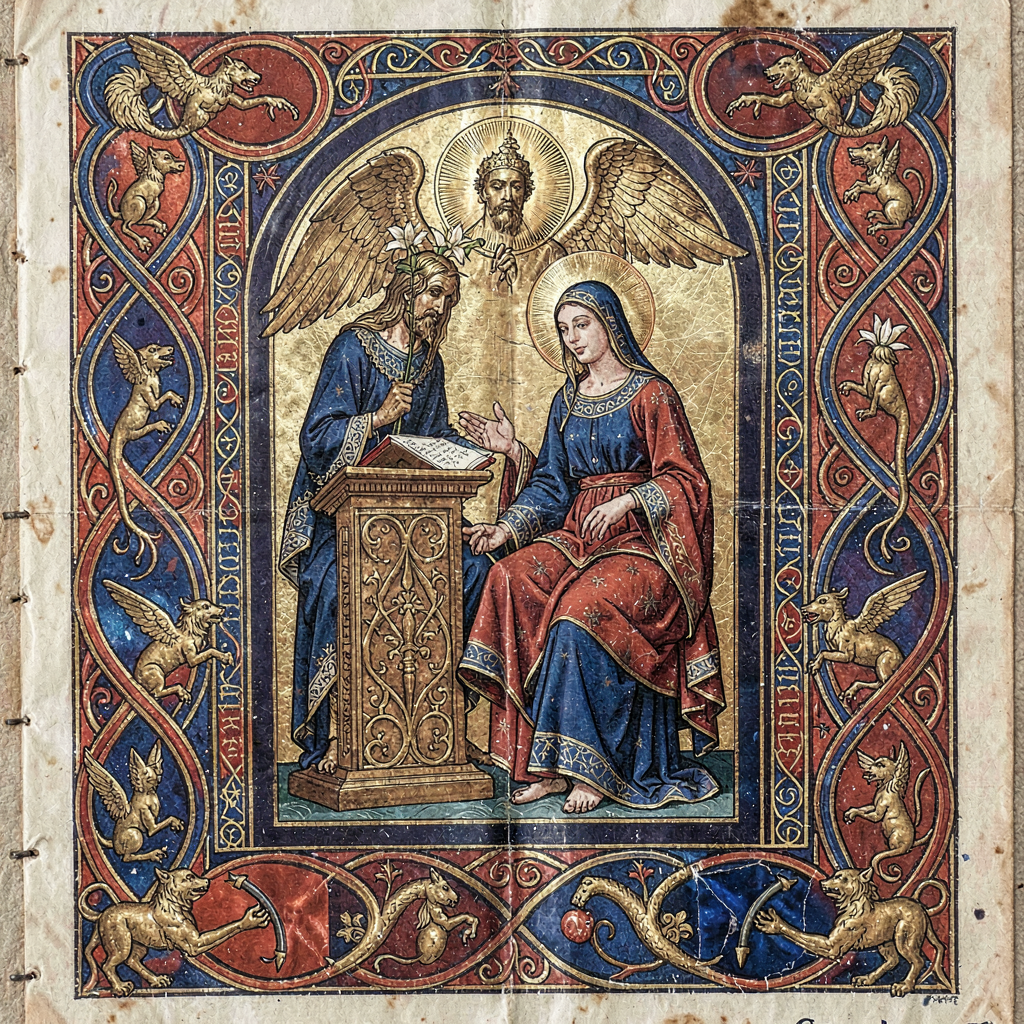
Both traditions accord Jesus profound reverence, centering on Maryam and miraculous signs. The Qur'an affirms his virgin birth, noting the angel's greeting in Surah Maryam, while Luke 1:28 records the Annunciation. Both texts depict him healing the blind and raising the dead, validating his prophetic authority. Yet the theological trajectories diverge sharply regarding his nature. Christianity, anchored in John 1:14, confesses the Word made flesh, asserting Jesus as the incarnate Son of God who died for humanity's redemption. Conversely, the Qur'an rigorously guards divine unity, rejecting sonship in Surah al-Ikhlas. Crucially, Surah An-Nisa 4:157 states he was neither killed nor crucified, but it appeared so, and he was raised to God. This denial of the Passion fundamentally alters soteriology: where Christianity sees atonement through the Cross, Islam views 'Isa as a sign of God's power who returns before the Last Day without having suffered death. Thus, while both honor him as al-Masih and a miracle-worker, the Christian narrative culminates in resurrection and divinity, whereas the Islamic narrative emphasizes his prophetic mission and ultimate ascension, preserving strict monotheism. These differences define the distinct spiritual landscapes of each faith, shaping how believers understand salvation, history, and the nature of God.
Jesus is the incarnate Son of God, crucified for sin, resurrected on the third day. Divine and human natures.
'Isa is a prophet, not divine. The Qur'an states he was not killed nor crucified, but it was made to appear so; he was raised to Allah (4:157). Divine sonship is rejected (112:3). His mother Maryam has an entire surah named for her (19).
No one has written anything here yet. Some places to begin:
Sign in to join the discussion.