Christianity
Luke
“And in the sixth month the angel Gabriel was sent from God unto a city of Galilee, named Nazareth,”
The only woman named in the Qur'an, and more often than in the New Testament. Surah 19 bears her name. A powerful comparative lens: the same figure, two scriptures, very different Christologies.
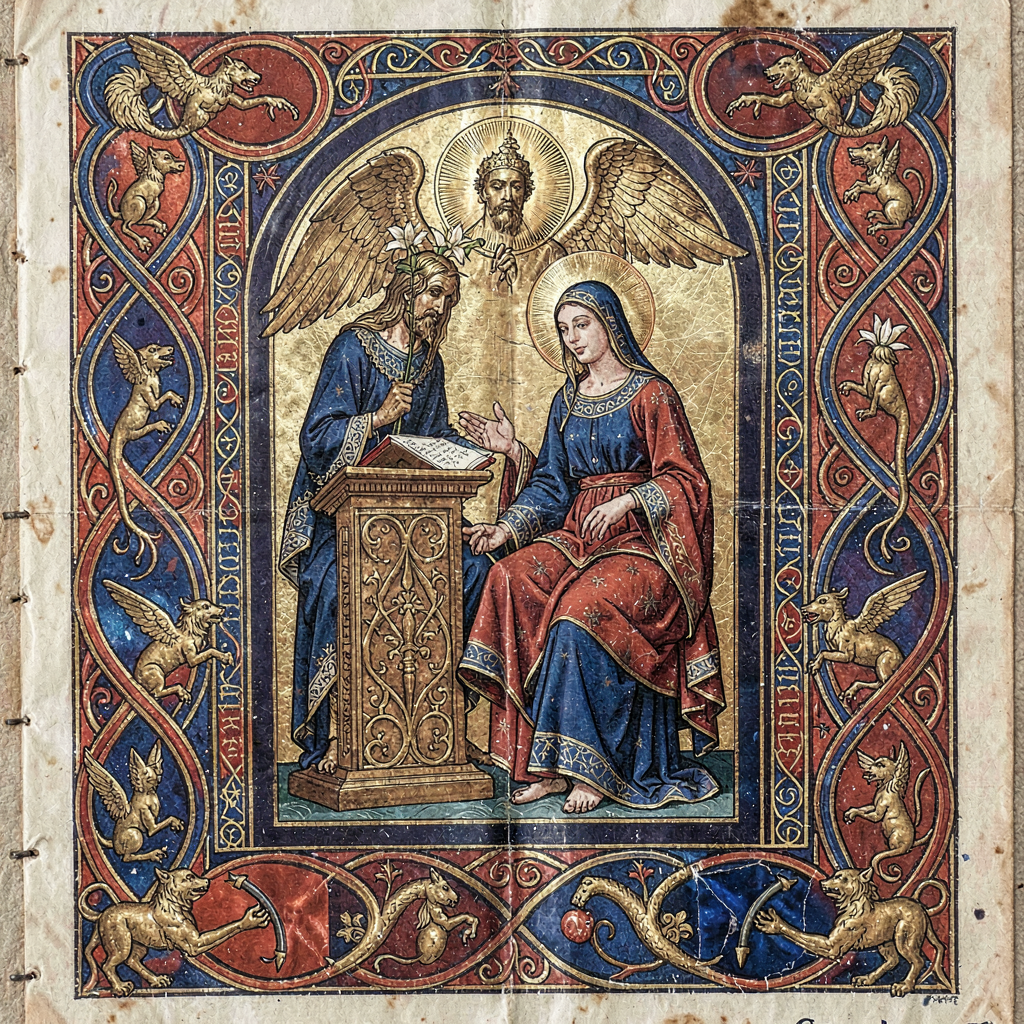
Both the New Testament and the Qur'an elevate Mary as a singular figure of devotion, yet their theological trajectories diverge sharply. In Luke 1:26, the angel Gabriel announces to Mary that she will conceive a son through the Holy Spirit, framing her as the Theotokos, the God-bearer central to Chalcedonian Christology. Conversely, the Qur'an dedicates an entire chapter, Surah Maryam, to her story, portraying Maryam as the greatest of women who conceives miraculously yet strictly denies any divine sonship. In Surah 19:16, the narrative emphasizes her withdrawal to a remote place, where she gives birth alone beneath a palm tree. The infant Jesus, speaking from the cradle in 19:30, defends her chastity and declares himself a servant of God, explicitly rejecting the notion of divine parenthood. While Christianity views Mary's 'yes' as a cooperative act of grace enabling the Incarnation, Islam honors her submission (islam) as the pinnacle of prophetic purity, separating her entirely from any ontological union with the divine. Jewish tradition, while revering the prophetess Miriam in Exodus 15:20 as a distinct archetype of holy leadership, generally regards the later narratives of Mary and Maryam as theological accretions that do not align with the Torah's portrayal of the Matriarchs. Thus, the shared motifs of annunciation and miraculous birth serve not to unify but to illuminate fundamentally different understandings of God's nature and the human vessel chosen to bear revelation.
Mary is theotokos — 'God-bearer' — in the Chalcedonian tradition; a paradigm of cooperation with grace.
Maryam is honoured as the greatest of women; she gives birth alone beneath a palm tree; the infant 'Isa speaks from the cradle in defense of her chastity (19:30).
While Mary of Nazareth is not a figure in the Hebrew Bible, the tradition of Miriam (sister of Moses and Aaron) serves as the primary biblical archetype of a holy woman and prophetess, distinct from the New Testament Mary. Jewish tradition generally views the Christian and Islamic narratives of Maryam as later accretions that do not align with the Torah's portrayal of the Matriarchs or the prophetic role of Miriam.
No one has written anything here yet. Some places to begin:
Sign in to join the discussion.