Christianity
2 Corinthians
“But we have this treasure in earthen vessels, that the excellency of the power may be of God, and not of us.”
Across these traditions, the human subject is metaphorically constructed as a vessel requiring emptiness or preparation to contain divine influence. While the imagery of fragility and utility is shared, the mechanisms of filling vary from miraculous multiplication to spiritual expansion. Scholars debate whether the emptiness represents a passive state or an active discipline of humility. Ultimately, the value is ascribed to the divine content rather than the material container.
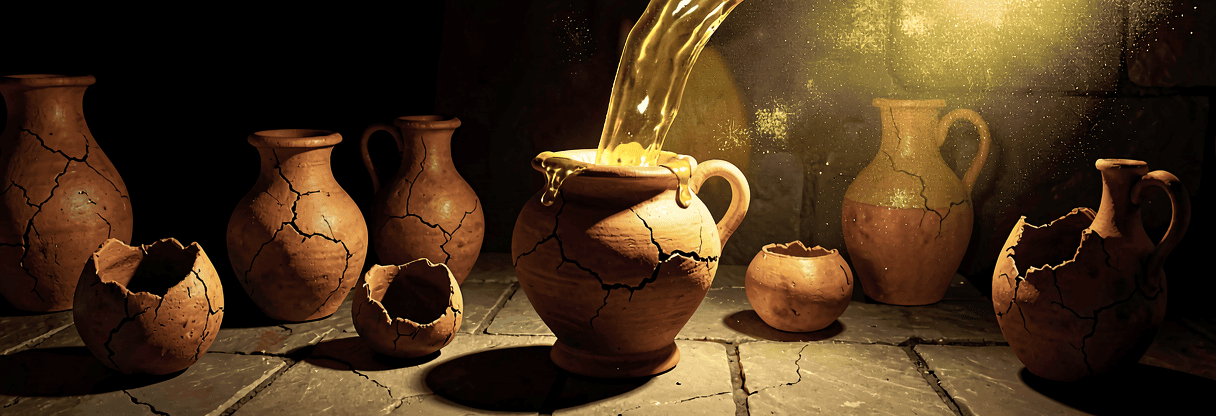
Across these traditions, the human subject is metaphorically constructed as a vessel requiring emptiness or preparation to contain divine influence. In Christianity, 2 Corinthians 4:7 states, "But we have this treasure in earthen vessels," emphasizing that inherent fragility highlights divine power rather than human capability. This paradox shifts focus from agency to grace. Conversely, Judaism highlights human responsibility within the divine-human dynamic. In 2 Kings 4:3, the command to "borrow thee vessels abroad" implies empty space must be created through effort before the miracle occurs, suggesting a cooperative sanctification where initiative precedes provision. Jeremiah 18:6 further contextualizes this relationship through the potter and clay imagery. Islam focuses on the internal expansion of the heart as the prerequisite for revelation. Surah 94:1 asks, "Have We not expanded for thee thy breast?" preparing the recipient for the "heavy word" described in Surah 73:5. Here, spiritual capacity outweighs physical objects. While all traditions agree the container's worth derives from its master's use, the mechanisms of filling vary significantly. Christianity emphasizes passive weakness, Judaism active gathering, and Islam internal readiness. Ultimately, the value is ascribed to the divine content rather than the material container, yet the path to receptivity defines distinct theological priorities regarding human agency and divine sovereignty.
This tradition emphasizes the paradox that the vessel's inherent weakness highlights the divine power within, shifting focus from human capability to grace. Consequently, the fragility of the human agent is not a defect but a necessary condition for the manifestation of divine strength.
This tradition highlights the human responsibility to gather the vessels, implying that empty space must be created through effort before the miracle occurs. Consequently, the narrative suggests a cooperative dynamic in sanctification where human initiative precedes divine provision.
This tradition focuses on the internal expansion of the breast or heart as the prerequisite for receiving the heavy word of revelation. Consequently, the metaphor prioritizes spiritual capacity and readiness over physical objects or external gathering.
Bowing low — the spiritual posture that every tradition treats as the door, not the threshold. From Moses 'meek above all men' to the Tao that humbles itself by being below.
Trust as substance — the faculty that the Letter to the Hebrews names the evidence of things unseen, and that every tradition makes the seed of every virtue.
No one has written anything here yet. Some places to begin:
Sign in to join the discussion.