Christianity
Matthew
“Another parable spake he unto them; The kingdom of heaven is like unto leaven, which a woman took, and hid in three measures of meal, till the whole was leavened.”
Both traditions utilize the imagery of leaven to delineate boundaries of holiness and community identity, though with opposing valences regarding the substance's moral quality. In the Hebrew Bible, leaven is strictly prohibited in sacrificial contexts and the Passover observance, symbolizing corruption or haste, whereas in the New Testament, it serves as a metaphor for the pervasive, transformative nature of the Kingdom of God. Scholars note that the Christian appropriation of the leaven motif repurposes a symbol of ritual impurity to illustrate spiritual expansion, creating a distinct theological divergence from the Mosaic legal framework.
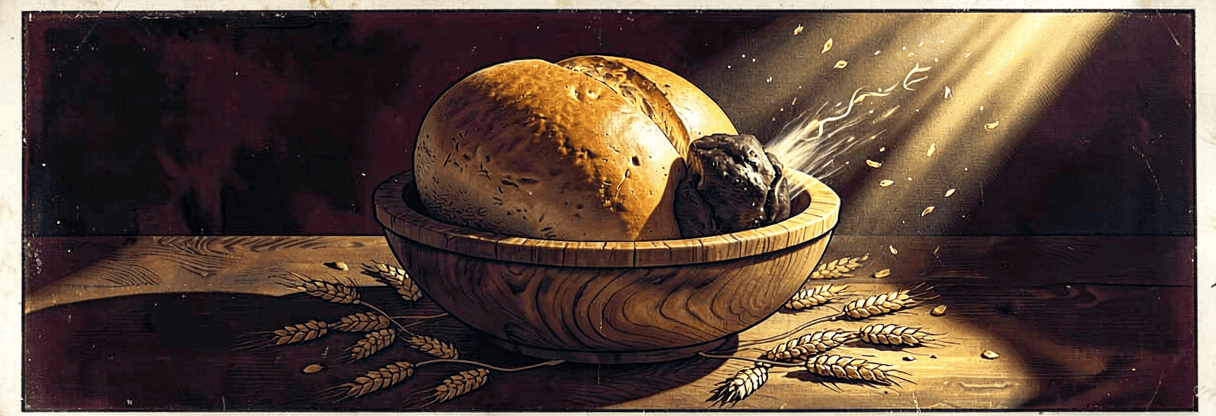
Both traditions deploy the imagery of leaven to map the boundaries of holiness and communal identity, yet they assign opposing moral valences to the substance. In the Hebrew Bible, leaven functions as a potent symbol of corruption or haste, strictly prohibited in sacrificial contexts to preserve ritual purity. Leviticus 2:11 mandates that 'No meat offering... shall be made with leaven,' while Exodus 12:15 commands the removal of leaven during Passover to commemorate the Exodus haste. Here, the small portion threatens to contaminate the whole, necessitating its exclusion. Conversely, the New Testament repurposes this symbol of impurity to illustrate the hidden, transformative growth of the Kingdom. In Matthew 13:33, Jesus declares, 'The kingdom of heaven is like unto leaven, which a woman took, and hid in three measures of meal,' transforming the agent of corruption into an agent of divine expansion. While Paul in 1 Corinthians 5:6 warns that 'a little leaven leaveneth the whole lump' regarding ethical conduct, the dominant parabolic usage reimagines the pervasive influence as positive. This hermeneutical shift creates a distinct theological divergence: where Judaism maintains leaven as a contaminant to be excised, Christianity appropriates the motif to describe the inevitable, hidden permeation of God's reign. The shared mechanism of the small affecting the whole remains constant, but the direction of that influence—whether toward ritual defilement or spiritual fulfillment—defines the critical distinction between the legal framework and the eschatological vision.
The leaven is reinterpreted from a symbol of ritual impurity to a positive metaphor for the Kingdom of Heaven's hidden growth. This represents a hermeneutical shift where the agent of corruption becomes the agent of divine transformation.
Leaven is consistently treated as a contaminant to be removed, particularly during the Passover festival and in grain offerings. The prohibition serves to maintain ritual purity and commemorate the haste of the Exodus.
No one has written anything here yet. Some places to begin:
Sign in to join the discussion.