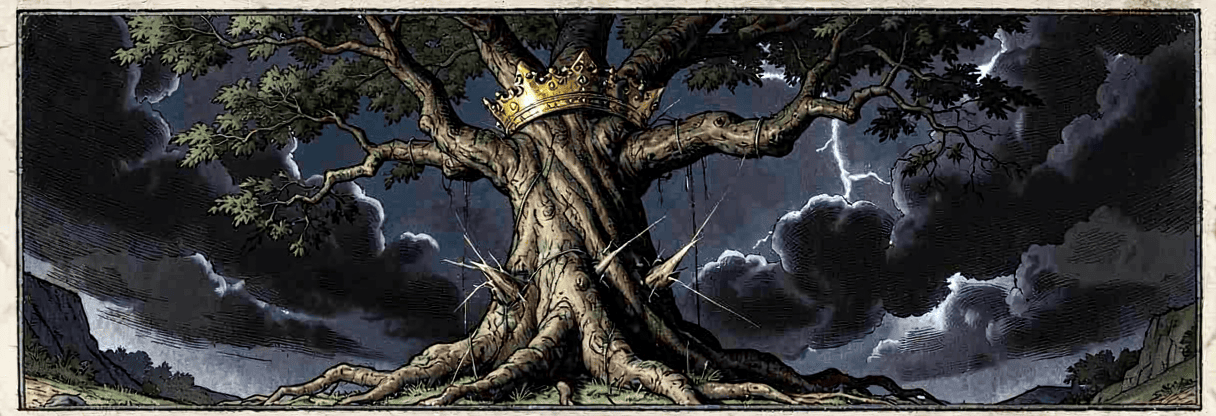
Rebellion
The first sin of the spirit, the recurring sin of the people — every tradition tells of the proud refusal that sets the soul against its source.
"And Cain talked with Abel his brother: and it came to pass, when they were in the field, that Cain rose up against Abel his brother, and slew him."
"And they gathered themselves together against Moses and against Aaron, and said unto them, Ye take too much upon you..."
"...I have nourished and brought up children, and they have rebelled against me."
"For rebellion is as the sin of witchcraft, and stubbornness is as iniquity and idolatry..."
"And [mention] when We said to the angels, 'Prostrate before Adam'; so they prostrated, except for Iblees..."
See this theme as a comparative study.
- Cain and Abel
Two brothers offer sacrifices, but only one is accepted by God. Jealousy leads to the first murder in human history.
- The Fall of Man
The first humans disobey a divine command in a garden setting. This act introduces sin and separation from the divine presence. 1 Enoch's Book of the Watchers, often read alongside the Edenic story, narrates a parallel cosmic corruption — the descent of fallen angels and their forbidden teachings — rather than re-telling the human Fall itself.
- Tower of Babel
Humanity attempts to build a tower reaching heaven to make a name for themselves. God confuses their languages and scatters them.
- Breaking the Idols
This parallel examines the motif of prophetic iconoclasm as a definitive rupture with ancestral polytheism. While the narrative of Abraham smashing idols in the Qur'an serves as a paradigmatic origin story for monotheistic rejection of images, the Hebrew Bible presents Moses destroying the Golden Calf and Hezekiah later dismantling the Nehushtan as acts of cultic purification within an established covenant. Christian tradition, particularly in Acts 17, shifts the focus from physical destruction to rhetorical deconstruction of idols in the Athenian Areopagus, reflecting a different missionary strategy. Scholars debate whether the Abraham narrative in the Qur'an is a midrashic elaboration of Genesis or an independent tradition emphasizing the prophet's logical refutation of idolatry.
Discussion
No one has written anything here yet. Some places to begin:
- Which verse landed hardest for you?
- What's a counter-text — a verse that complicates this theme?
- How does this theme show up in a tradition not represented here?
Sign in to join the discussion.