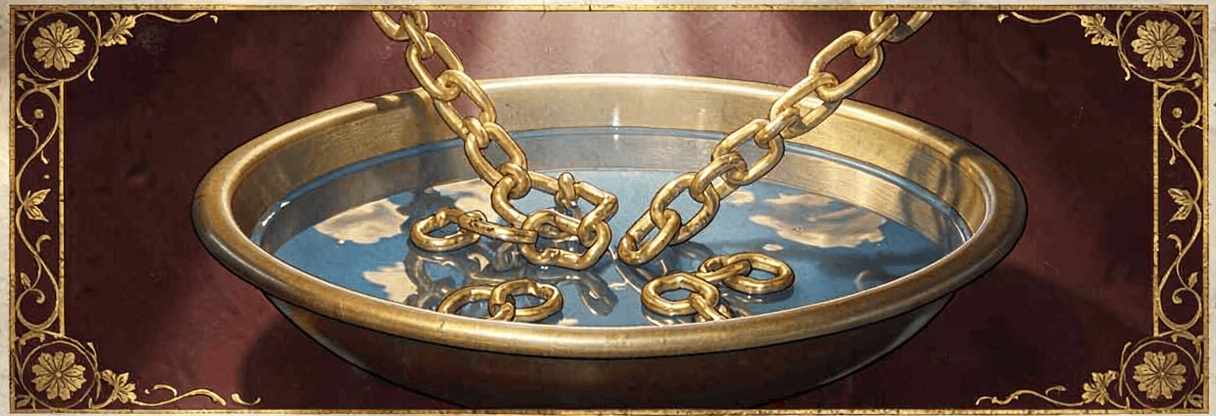
The Debt
What is owed and what is forgiven — every tradition treats moral debt as the language of the soul before God and the neighbor.
"At the end of every seven years thou shalt make a release."
See this theme as a comparative study.
- The Prodigal's Return
This parallel examines the motif of the estranged soul returning to divine favor across Abrahamic and Buddhist traditions. While Christianity and Islam emphasize a personal God who actively awaits and forgives the repentant sinner, the Buddhist account in the Dhammapada frames the 'return' as an internal realization of the Dhamma rather than a relational reconciliation with a deity. Scholars note that the Abrahamic narratives often involve a narrative of restoration to community status, whereas the Buddhist verse focuses on the cessation of suffering through self-discipline. The shared core remains the transition from a state of error or loss to one of spiritual restoration.
- The Camel and the Needle
This parallel examines the motif of wealth as a barrier to spiritual attainment across Abrahamic and Dharmic traditions. While Christianity employs the hyperbolic image of a camel passing through a needle's eye to illustrate the impossibility of salvation through riches alone, Judaism and Islam frame the issue through warnings against trust in material accumulation and the sin of hoarding. Buddhism diverges by focusing on the internal mechanism of attachment rather than external economic status, positing that the renunciation of desire is the prerequisite for liberation. Scholars debate whether the needle's eye represents a literal small gate or a rhetorical device for absolute impossibility, a distinction less relevant in the other traditions where the focus remains on the moral hazard of wealth itself.
Discussion
No one has written anything here yet. Some places to begin:
- Which verse landed hardest for you?
- What's a counter-text — a verse that complicates this theme?
- How does this theme show up in a tradition not represented here?
Sign in to join the discussion.