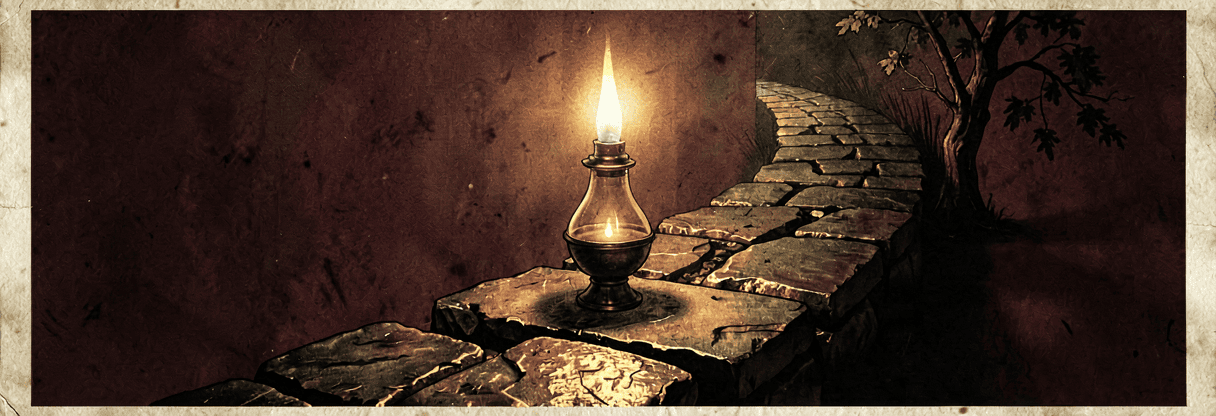
The Lamp
Thy word is a lamp unto my feet — every tradition makes the small steady light the figure of the Word that does not fail in the long dark watch.
"Thy word is a lamp unto my feet, and a light unto my path."
"For thou wilt light my candle: the LORD my God will enlighten my darkness."
"The spirit of man is the candle of the LORD, searching all the inward parts of the belly."
"Neither do men light a candle, and put it under a bushel, but on a candlestick; and it giveth light unto all that are in the house."
"Then shall the kingdom of heaven be likened unto ten virgins, which took their lamps, and went forth to meet the bridegroom."
"And the city had no need of the sun, neither of the moon, to shine in it: for the glory of God did lighten it, and the Lamb is the light thereof."
See this theme as a comparative study.
- Light of the World
The motif of light functions across these traditions as both a descriptor of divine presence and a vocation for the faithful. While the Hebrew Bible and Christianity emphasize the communal or individual role of believers as bearers of light, Islam focuses on God as the sole source of cosmic and spiritual illumination, with believers reflecting that light. Buddhism frames the awakened one as a lamp or light that dispels the darkness of ignorance, emphasizing internal realization over external revelation. Scholars note that while the imagery is shared, the ontological status of the light—whether it is an attribute of the believer, a reflection of the Divine, or a metaphor for wisdom—varies significantly.
- Tongues of Fire
This parallel examines the motif of divine speech manifesting as or accompanied by fire across Abrahamic traditions. In Christianity, the Holy Spirit descends as cloven tongues of fire enabling glossolalia; in Judaism, the prophetic word is explicitly compared to a burning fire that consumes; in Islam, the burning bush serves as the medium for divine address to Moses. While all three utilize fire to signify the purifying and empowering nature of revelation, they diverge on whether the fire is the medium of the voice itself or a symbol of the message's potency.
Discussion
No one has written anything here yet. Some places to begin:
- Which verse landed hardest for you?
- What's a counter-text — a verse that complicates this theme?
- How does this theme show up in a tradition not represented here?
Sign in to join the discussion.