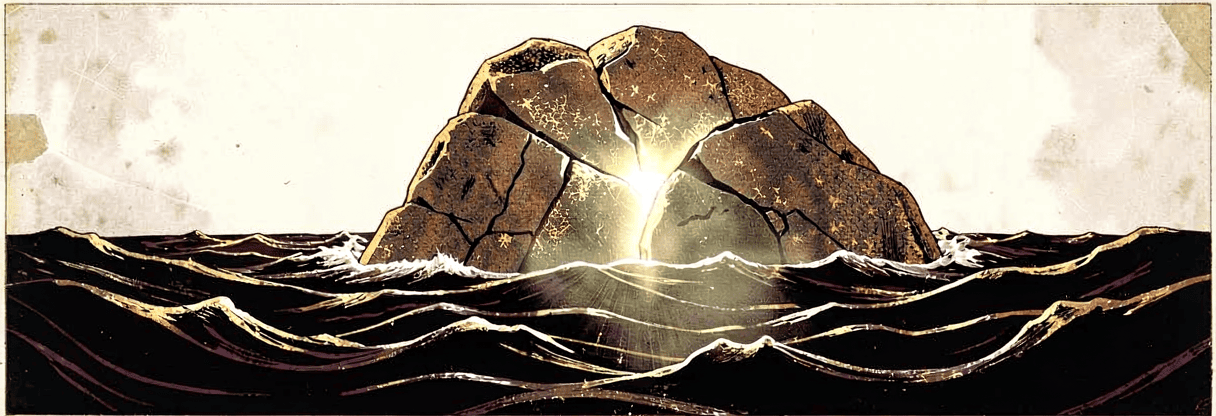
The Rock
Unshaken foundation — every tradition names the divine as the Rock under the feet of the faithful and the cleft in which the soul is hid.
"The LORD is my rock, and my fortress, and my deliverer; my God, my strength, in whom I will trust..."
"Trust ye in the LORD for ever: for in the LORD JEHOVAH is everlasting strength."
See this theme as a comparative study.
- The Cornerstone
The motif of a divinely appointed foundation stone serves as a theological anchor in Judaism, Christianity, and Islam, representing stability, election, and the legitimacy of worship. While Judaism and Christianity identify this stone with Yahweh's presence in Zion or the person of Jesus Christ respectively, Islam locates the foundational act in the physical raising of the Kaaba by Abraham and Ishmael. Scholars note that the Christian interpretation often functions christologically to supersede the Jewish temple cult, whereas the Islamic narrative emphasizes the restoration of the primordial monotheistic sanctuary.
- The Stone the Builders Rejected
This motif identifies a figure or entity despised by established authorities who is subsequently exalted by divine agency, serving as a cornerstone of a new order. While Judaism and Christianity explicitly utilize the architectural metaphor of a 'stone' to describe this reversal, Islam articulates the same theological pattern through the narrative of prophets rejected by their communities yet vindicated by God. Scholars note that the Christian application of this text to Jesus represents a christological reading of the Hebrew Psalms, whereas the Islamic tradition emphasizes the historical continuity of prophetic rejection without necessarily employing the specific stone imagery in the same typological manner.
- Pillar of Cloud, Pillar of Fire
The motif of a visible, mobile divine presence guiding a community through wilderness terrain appears prominently in the Hebrew Bible and is reinterpreted in the New Testament and the Qur'an. While the Hebrew Bible describes a literal pillar of cloud and fire leading the Israelites, the New Testament typologically identifies this event as a prefiguration of Christian baptism and spiritual sustenance. The Qur'an affirms the guidance of Moses but omits the specific pillar imagery, focusing instead on divine provision and the separation of the sea as signs of Allah's protection.
Discussion
No one has written anything here yet. Some places to begin:
- Which verse landed hardest for you?
- What's a counter-text — a verse that complicates this theme?
- How does this theme show up in a tradition not represented here?
Sign in to join the discussion.