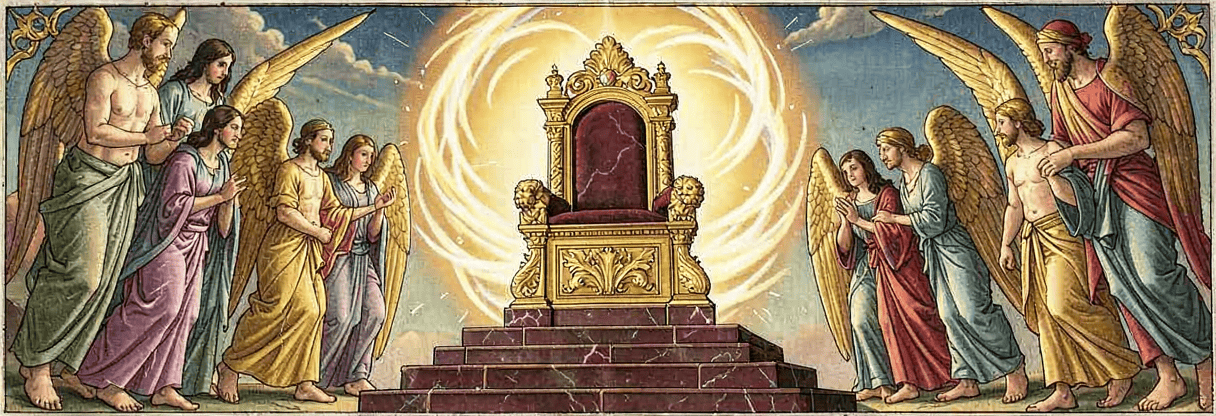
The Throne
The seat above the cherubim — every tradition figures the divine sovereignty as a throne, attended by the unceasing song of those who see and do not look away.
"...I saw also the Lord sitting upon a throne, high and lifted up, and his train filled the temple."
"...the likeness of a throne, as the appearance of a sapphire stone..."
"God reigneth over the heathen: God sitteth upon the throne of his holiness."
"...the Ancient of days did sit, whose garment was white as snow, and the hair of his head like the pure wool: his throne was like the fiery flame..."
See this theme as a comparative study.
- The Vision of the Throne
A prophet or seer is drawn up into heaven and beholds God enthroned in fire, crystal, and light, surrounded by radiant attendants. The vision consecrates the seer as witness and messenger — a pattern that recurs from Isaiah in the eighth century BCE to Lehi on the 1830 American frontier.
- Before the Throne
Abrahamic traditions converge on the imagery of a supreme divine tribunal where cosmic order is restored through the assessment of human deeds. While Judaism and Christianity emphasize the visual majesty of the Ancient of Days and the Great White Throne, Islam introduces the specific mechanism of the scales to weigh actions. Scholars note that the Christian synthesis of judgment often incorporates ethical dichotomies absent in the more legalistic or cosmic balancing found in Jewish and Islamic eschatologies.
Discussion
No one has written anything here yet. Some places to begin:
- Which verse landed hardest for you?
- What's a counter-text — a verse that complicates this theme?
- How does this theme show up in a tradition not represented here?
Sign in to join the discussion.