Christianity
Genesis
“And he said, Take now thy son, thine only son Isaac, whom thou lovest, and get thee into the land of Moriah; and offer him there for a burnt offering upon one of the mountains which I will tell thee of.”
A father is commanded to sacrifice his own son as a test of faith; at the last moment a substitute is provided. Central to Jewish, Christian, and Islamic identity, though the identity of the son differs between the Bible and the Qur'an.
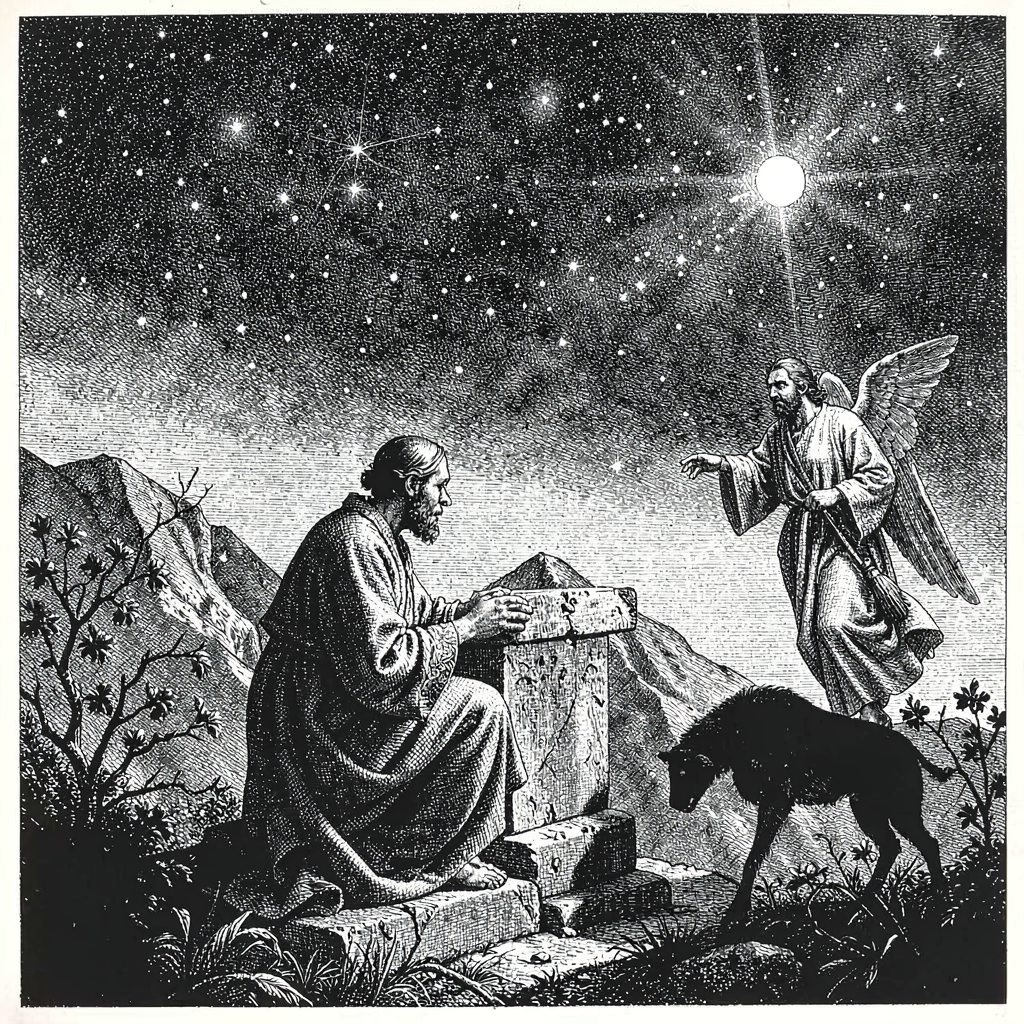
The narrative of the binding presents a profound convergence of monotheistic devotion, centering on a father’s radical obedience and the divine provision of a substitute. In Genesis 22, God commands Abraham to offer his son, a test resolved when 'a ram caught in a thicket' is provided in place of the child. This motif of willing submission resonates deeply across traditions, yet the identity of the son marks a critical theological divergence. Jewish and Christian exegesis, grounded in Genesis 22:2, identify the son as Isaac, linking the event to the Temple Mount and, in Christian typology, to Christ’s sacrifice. Conversely, Islamic tradition, citing Surah 37:102, names Ishmael, emphasizing his active consent: 'O my father, do as you are commanded.' While the Akedah is commemorated annually in Judaism and serves as a Christological foreshadowing in Christianity, Islam marks the event at Eid al-Adha, celebrating the total surrender of both father and son. Despite these distinct lineages, the shared core remains the absolute prioritization of divine will over natural affection. The ram’s provision signifies that God demands faith, not death, establishing a covenant of blessing that multiplies offspring in each tradition. Thus, the story functions not merely as a historical memory but as a living archetype of faith, where the tension between human loss and divine mercy is eternally resolved through substitution.
The son is Isaac. Christian theology reads the event typologically as foreshadowing Christ's crucifixion on the same Moriah tradition.
Called the Akedah ('the Binding'). Read annually at Rosh Hashanah. Isaac is the son; the mountain is Moriah, later identified with the Temple Mount.
The son is Ishmael (Isma'il). Commemorated at Eid al-Adha. Ishmael willingly submits: 'O my father, do as you are commanded; you shall find me, God willing, of the steadfast' (37:102).
Atonement for sin requires a life given in place of another, pointing ultimately to Christ. Old covenant rituals foreshadowed this ultimate payment.
Trust as substance — the faculty that the Letter to the Hebrews names the evidence of things unseen, and that every tradition makes the seed of every virtue.
The set-apart table where the world ends and the offering begins — every tradition orients its piety toward an altar, even when the altar is unseen.
No one has written anything here yet. Some places to begin:
Sign in to join the discussion.