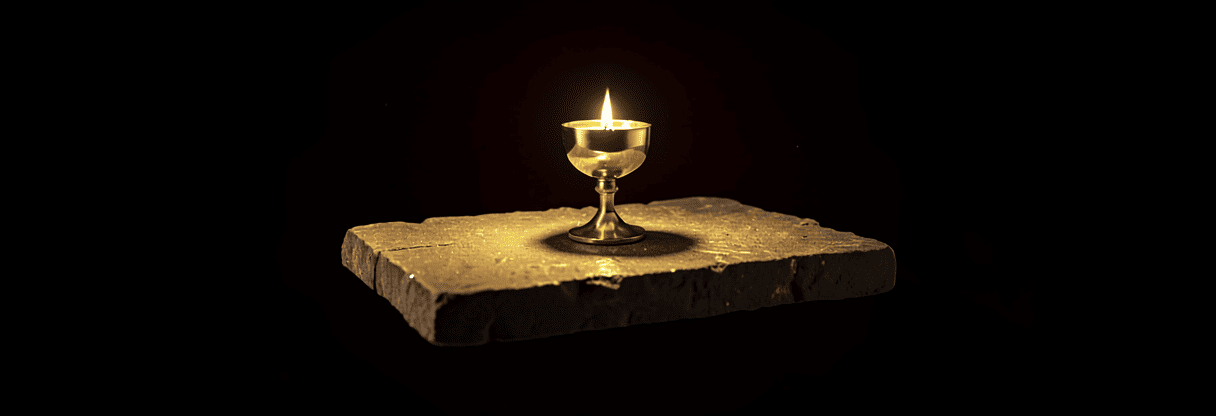
The Altar
The set-apart table where the world ends and the offering begins — every tradition orients its piety toward an altar, even when the altar is unseen.
"And Noah builded an altar unto the LORD; and took of every clean beast, and of every clean fowl, and offered burnt offerings on the altar."
"An altar of earth thou shalt make unto me, and shalt sacrifice thereon thy burnt offerings..."
"And Elijah said unto all the people, Come near unto me. And all the people came near unto him. And he repaired the altar of the LORD that was broken down."
"Leave there thy gift before the altar, and go thy way; first be reconciled to thy brother, and then come and offer thy gift."
"We have an altar, whereof they have no right to eat which serve the tabernacle."
"And another angel came and stood at the altar, having a golden censer; and there was given unto him much incense..."
See this theme as a comparative study.
- The Altar
Across these traditions, the altar functions as a consecrated locus where the human and divine realms intersect through ritual offering. While Judaism and early Christianity emphasize the structural or typological significance of the stone table, Hinduism focuses on the fire itself as the divine agent. Scholarly debate persists regarding whether these parallels indicate a shared archaic Indo-European heritage or independent developments in sacrificial theology.
- The Binding — Abraham's Sacrifice
A father is commanded to sacrifice his own son as a test of faith; at the last moment a substitute is provided. Central to Jewish, Christian, and Islamic identity, though the identity of the son differs between the Bible and the Qur'an.
- Incense
The imagery of incense smoke ascending serves as a universal metaphor for prayer reaching the divine across ancient Near Eastern, Jewish, and Christian traditions. While the ritual function of incense in the Hebrew Bible is tied to the sanctuary and the atonement of the priesthood, the New Testament reinterprets this imagery to describe the collective prayers of the saints as a spiritual offering. Scholars note a significant divergence wherein the later Christian text internalizes and universalizes the cultic act, whereas the Hebrew texts maintain a strict geographical and priestly limitation on the burning of incense.
Discussion
No one has written anything here yet. Some places to begin:
- Which verse landed hardest for you?
- What's a counter-text — a verse that complicates this theme?
- How does this theme show up in a tradition not represented here?
Sign in to join the discussion.