Christianity
Genesis
“And out of the ground made the LORD God to grow every tree that is pleasant to the sight, and good for food; the tree of life also in the midst of the garden, and the tree of knowledge of good and evil.”
A motif of enlightenment arriving beneath a sacred tree — most prominently, the Buddha's awakening under the Bodhi tree. Compare with the Tree of Knowledge and the Tree of Life in the Abrahamic traditions, and the Ashvattha (cosmic fig tree) of the Bhagavad Gita.
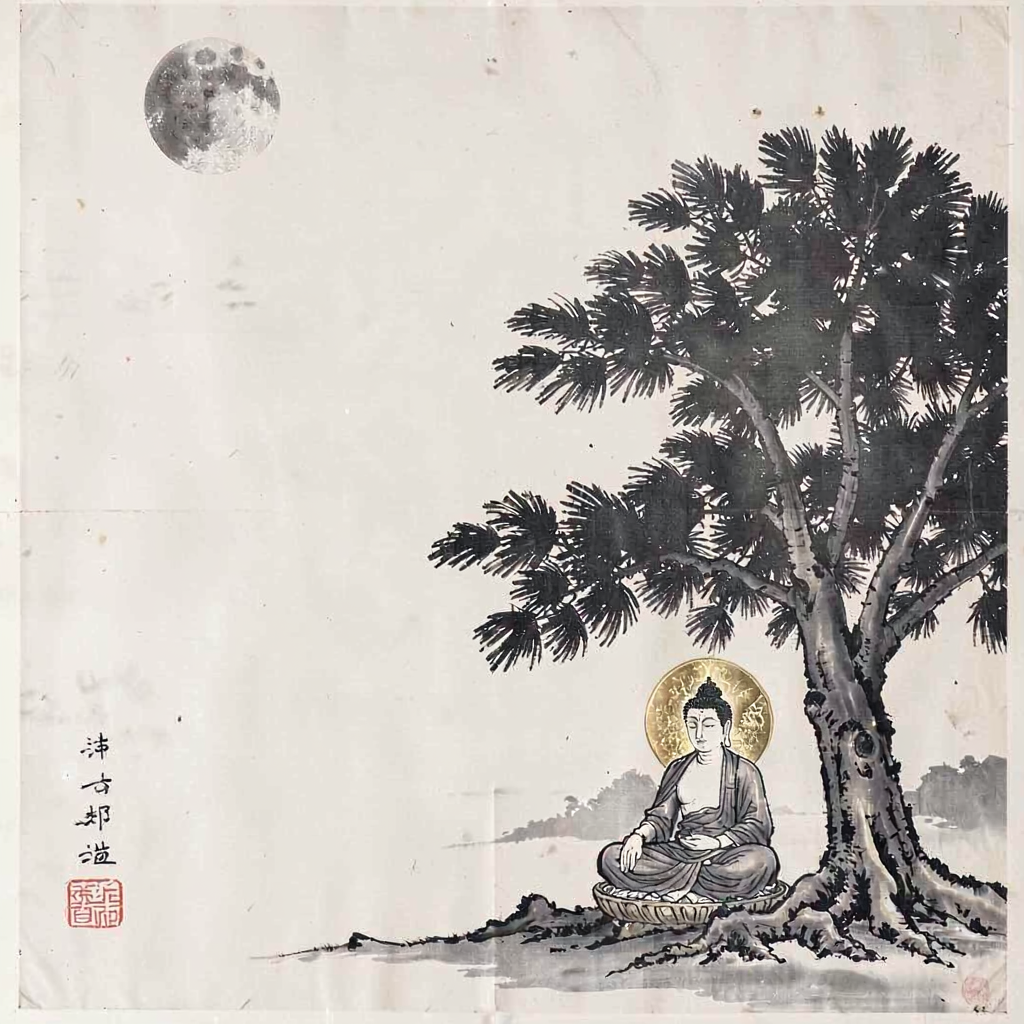
The motif of awakening beneath a tree serves as a profound axis for cosmic insight across diverse traditions, yet the nature of that insight diverges significantly. In Buddhism, Siddhartha Gautama resolves to remain seated under the pipal tree until he attains full awakening, embodying a transformative internal realization. The Dhammapada encapsulates this ethic: "Not to commit any sin, to do good, and to purify one's mind — that is the teaching of all the Awakened." Here, the tree marks the threshold where ignorance yields to enlightenment through disciplined practice. Conversely, in the Abrahamic narrative of Genesis, the trees in Eden represent a fatal choice between obedience and disobedience. Genesis 3:6 describes the woman seeing that the tree of knowledge was "good for food," leading to exile rather than liberation. While the Tree of Life remains a symbol of restored communion, the immediate outcome is separation. Hinduism offers a metaphysical inversion in the Bhagavad Gita 15:15, depicting the eternal Ashvattha with "roots above and branches below," suggesting a cosmic structure where the divine source transcends the material world. Furthermore, Christian tradition reinterprets the tree typologically, identifying the cross as the instrument of redemption that reverses Eden's curse. Thus, while all traditions utilize the arboreal symbol to mediate between the human and the divine, Buddhism emphasizes self-realization, Judaism and Christianity focus on moral choice and redemption, and Hinduism contemplates the cosmic order itself.
Siddhartha sits under a pipal tree (Ficus religiosa) at Bodh Gaya, resolves not to rise until he achieves awakening, and becomes the Buddha.
The Tree of Knowledge and Tree of Life flank the narrative of Eden; eating from one banishes Adam and Eve but gestures toward the other.
The cross is frequently called 'the tree' in apostolic preaching (Acts 5:30, 1 Peter 2:24), consciously echoing Eden.
The Bhagavad Gita 15.1 speaks of the eternal Ashvattha tree with its roots above and branches below.
No one has written anything here yet. Some places to begin:
Sign in to join the discussion.