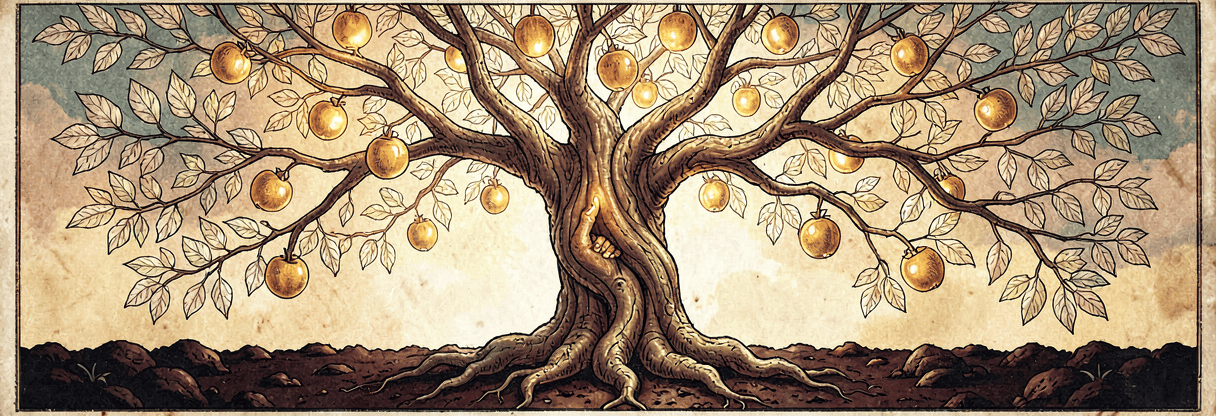
The Tree
The tree of life, the tree of knowledge, the Bodhi tree, the tree planted by water — every tradition makes the rooted, fruit-bearing tree the figure of the righteous soul and of cosmic order.
"...the tree of life also in the midst of the garden, and the tree of knowledge of good and evil."
"And he shall be like a tree planted by the rivers of water, that bringeth forth his fruit in his season..."
"She is a tree of life to them that lay hold upon her: and happy is every one that retaineth her."
"For he shall be as a tree planted by the waters, and that spreadeth out her roots by the river..."
See this theme as a comparative study.
- The Tree of Life
The motif of a cosmic tree serving as the axis mundi and source of immortality appears across multiple traditions, often situated at the center of a paradisiacal realm. While Abrahamic faiths emphasize the tree as a divine gift lost or restored, Eastern traditions frequently depict it as a symbol of the inverted nature of worldly existence or the locus of enlightenment. Scholarly debate continues regarding whether these parallels stem from a shared ancient Near Eastern archetype or independent theological developments addressing the human condition.
- Awakening Under a Tree
A motif of enlightenment arriving beneath a sacred tree — most prominently, the Buddha's awakening under the Bodhi tree. Compare with the Tree of Knowledge and the Tree of Life in the Abrahamic traditions, and the Ashvattha (cosmic fig tree) of the Bhagavad Gita.
- The Vine and the Branches
This parallel examines the metaphor of organic union between the divine and the believer, utilizing botanical imagery of sap, fruit, and pruning. While Christianity and Judaism share the specific motif of Israel or the believer as a vineyard tended by God, Islam adapts the imagery to a 'goodly tree' with firm roots, emphasizing stability over the specific vineyard metaphor. Hinduism contributes a distinct inverted tree (Ashvattha) representing cosmic structure and the need to sever attachment, diverging from the relational intimacy found in the Abrahamic traditions. Scholars note that while the pruning motif signifies ethical refinement in Christianity, it functions as a metaphor for detachment from the material world in the Gita.
- The Grafted Branch
This parallel examines the motif of the wild stock joined to the cultivated tree, found explicitly in Pauline theology and metaphorically in prophetic and Qur'anic imagery. While Christianity articulates a soteriological grafting of Gentiles into the historic people of God, Judaism employs the olive tree as a symbol of Israel's intrinsic, divinely rooted vitality, and Islam utilizes the tree metaphor to describe the stability of the believer's faith rather than a structural union with a prior lineage. Scholars note that the Pauline concept of grafting implies a conditional inclusion dependent on faith, whereas the prophetic and Qur'anic images emphasize the organic, unbroken continuity of the righteous community.
- The Rod That Buds
This parallel examines the motif of a dead or cut staff miraculously flowering to signify divine election, primarily centered on the Aaronic narrative. While Judaism and Christianity share the historical account of Aaron's rod, Christianity uniquely extends the imagery typologically to Christ and the Church, whereas Judaism retains the focus on priestly legitimacy and messianic hope through the 'Branch' of Jesse. The divergence lies in the shift from a specific institutional sign to a universal soteriological symbol.
- The Fruitless Tree Judged
Both Christian and Jewish traditions utilize the fig tree as a potent metaphor for national covenant fidelity, where the presence of leaves without fruit signifies deceptive religiosity or impending judgment. While the Synoptic Gospels present a narrative of immediate, miraculous withering as a sign of eschatological authority, the Hebrew Prophets employ the imagery within a historical framework of collective punishment and prophetic warning. Scholars note that the Christian account transforms the prophetic metaphor into a performative act, whereas the Jewish texts maintain the symbol as a descriptive prophecy of agricultural and social desolation.
Discussion
No one has written anything here yet. Some places to begin:
- Which verse landed hardest for you?
- What's a counter-text — a verse that complicates this theme?
- How does this theme show up in a tradition not represented here?
Sign in to join the discussion.