Judaism
Psalms
“God is our refuge and strength, a very present help in trouble.”
Across Abrahamic traditions, the divine is frequently invoked as a sanctuary against existential peril, though the locus of safety shifts from a communal fortress to an internalized spiritual state. While Hebrew and Christian texts emphasize Yahweh as a physical stronghold and gathering point for the faithful, the Islamic tradition focuses on the ritual invocation of refuge (isti'adha) against specific spiritual and temporal harms. A significant divergence arises in the Buddhist perspective, which critically deconstructs the concept of external refuge, positing that true safety is found only in the realization of the Dhamma rather than in any deity.
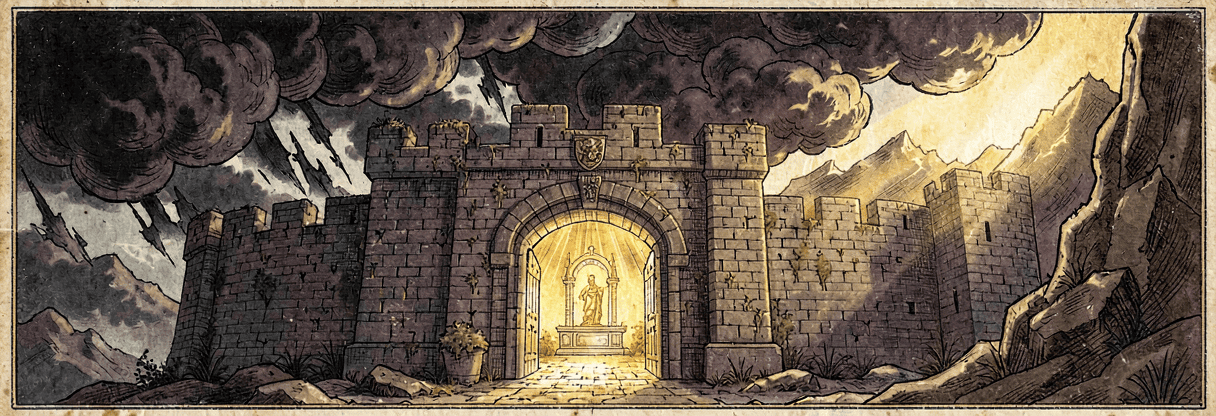
Across the Abrahamic traditions, the metaphor of divine refuge addresses the universal human condition of vulnerability. In Hebrew scripture, this safety is often spatial and communal. Psalm 46:1 declares, "God is our refuge and strength," while Proverbs 18:10 depicts the divine name as a "strong tower" into which the righteous physically run for protection. This imagery reflects a covenantal theology where safety is inextricably linked to the collective identity of Israel and God's historical interventions as a warrior-protector. Christian texts retain this fortress imagery but internalize and eschatologize it. Hebrews 6:18 offers "strong consolation" through God's immutable promises, bridging present spiritual reality with future hope. Yet, Matthew 23:37 complicates this by lamenting Jerusalem's rejection of divine gathering, suggesting that the refuge is contingent upon acceptance rather than mere proximity. In Islam, the concept shifts from a static location to a dynamic, liturgical act. The Mu'awwidhatayn (Surah 113 and 114) formalize the seeking of refuge (isti'adha) as a constant practice against specific harms, from the "evil of what He has created" to the "whisperings of Satan." Here, safety is not a fortress one enters once, but a continuous reliance on Allah's immediate protection. While all three traditions affirm that the divine is the ultimate sanctuary, the locus of safety moves from the external, historical stronghold of Judaism, through the eschatological hope of Christianity, to the internalized, ritualized dependence found in Islamic devotion.
In the Psalms, the refuge is often depicted as a tangible fortress or tower, emphasizing God's role as a warrior-protector who physically shields the righteous from enemies. This reflects a covenantal theology where safety is tied to the collective identity of Israel and the historical acts of God.
Christian texts retain the imagery of the fortress but expand it to include the eschatological hope of gathering under divine care, as seen in Jesus' lament over Jerusalem. The refuge becomes both a present spiritual reality and a future hope, bridging the gap between the historical and the messianic.
The Islamic tradition formalizes the seeking of refuge into a specific liturgical practice (isti'adha) recited before reading the Qur'an or facing temptation. This emphasizes the believer's constant dependence on Allah's protection from both visible and invisible forces, particularly Satan.
The problem of pain. Where Buddhism begins (the First Noble Truth), Job wrestles, Paul reframes, and the Gita redirects.
The 'beginning of wisdom' that every tradition distinguishes from terror — the awe of the small soul before the unbearable nearness of the Holy.
Cover of the wing, shade in the desert, the brevity of every life — every tradition reads the shadow as both refuge and reminder of the body's passing.
No one has written anything here yet. Some places to begin:
Sign in to join the discussion.