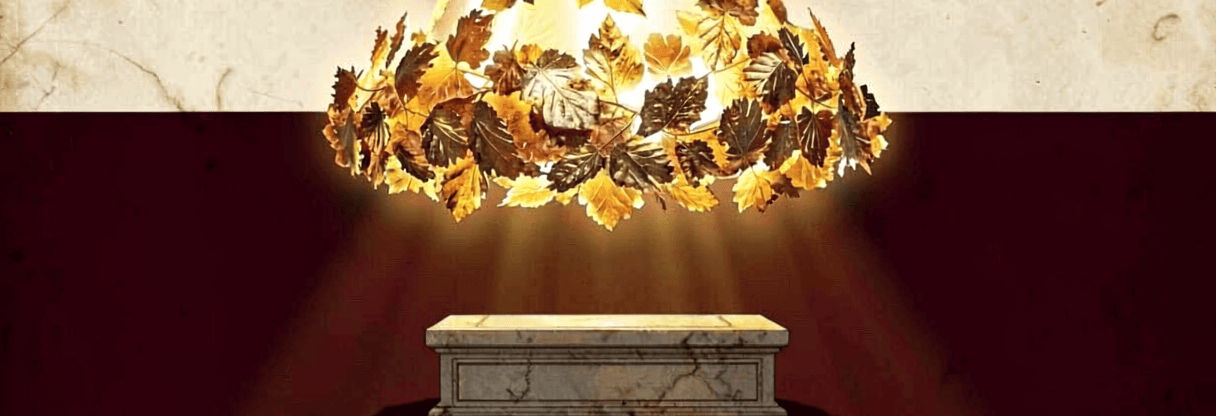
Glory
Kavod, doxa, dakhsha — the heavy weight of presence that crowns the Holy and the saint.
"And he said, I beseech thee, shew me thy glory."
"...Holy, holy, holy, is the LORD of hosts: the whole earth is full of his glory."
"And the Word was made flesh, and dwelt among us, (and we beheld his glory, the glory as of the only begotten of the Father,) full of grace and truth."
"...we all, with open face beholding as in a glass the glory of the Lord, are changed into the same image from glory to glory..."
"Allah is the Light of the heavens and the earth..."
See this theme as a comparative study.
- Theophany
Across these traditions, divine self-disclosure is frequently mediated through elemental phenomena such as fire, cloud, or overwhelming light, signifying a boundary between the immanent and the transcendent. While the phenomenological markers of fire and light serve as common vehicles for revelation, the theological implications diverge regarding the nature of the divine presence: whether it is localized, incarnate, or strictly ineffable. Scholars note that in Abrahamic contexts, theophany often validates prophetic authority, whereas in Hindu contexts, it frequently reveals the cosmic form of the deity to the devotee.
- The Vision of the Throne
A prophet or seer is drawn up into heaven and beholds God enthroned in fire, crystal, and light, surrounded by radiant attendants. The vision consecrates the seer as witness and messenger — a pattern that recurs from Isaiah in the eighth century BCE to Lehi on the 1830 American frontier.
- Robed in Light
This parallel examines the metaphor of divine glory manifesting as a garment of light across Abrahamic traditions. While the Hebrew Bible and the New Testament depict this imagery as either a divine attribute or a transformative state for the righteous, the Qur'anic formulation in Surah An-Nur presents light as the fundamental ontological reality of God, with the 'garment' serving as a theological metaphor for His self-disclosure rather than a physical covering. Scholars note that the Christian Transfiguration narrative emphasizes the eschatological transformation of the human body, whereas the Jewish poetic tradition focuses on the Creator's inherent majesty, and the Islamic text centers on the divine guidance permeating creation.
- Two Mountains, Two Glories
The motif of the mountain serves as a universal liminal space where the divine intersects with the human in these three traditions. In Judaism and Islam, the peak functions primarily as a site of revelation and divine oath, often associated with law or prophetic history. Christianity reinterprets this geography through the Transfiguration, where the mountain becomes a locus of Christological fulfillment rather than legal codification. Scholars debate whether these narratives represent independent developments or a shared ancient Near Eastern heritage regarding sacred topography.
- The Rod That Buds
This parallel examines the motif of a dead or cut staff miraculously flowering to signify divine election, primarily centered on the Aaronic narrative. While Judaism and Christianity share the historical account of Aaron's rod, Christianity uniquely extends the imagery typologically to Christ and the Church, whereas Judaism retains the focus on priestly legitimacy and messianic hope through the 'Branch' of Jesse. The divergence lies in the shift from a specific institutional sign to a universal soteriological symbol.
Discussion
No one has written anything here yet. Some places to begin:
- Which verse landed hardest for you?
- What's a counter-text — a verse that complicates this theme?
- How does this theme show up in a tradition not represented here?
Sign in to join the discussion.