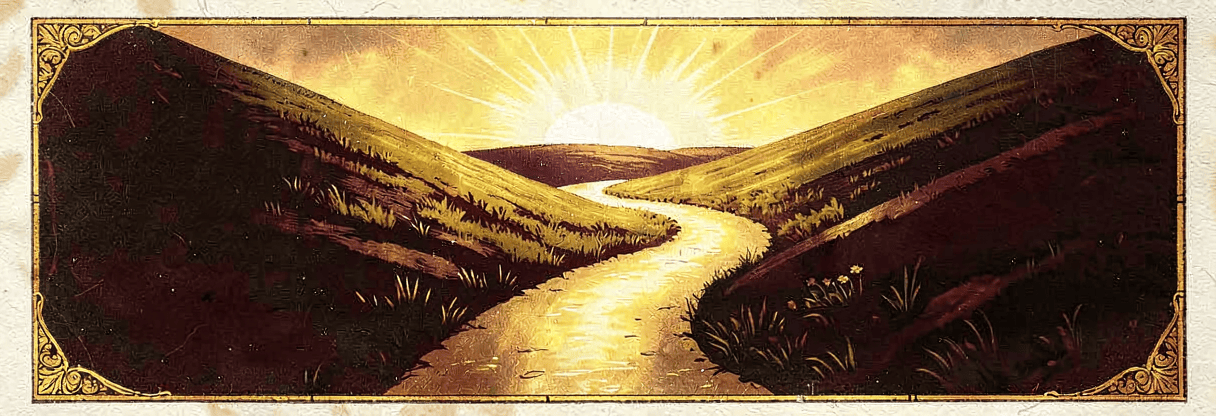
The Road
The way the soul must walk — every tradition figures the spiritual life as a road, and warns of every junction where the path divides.
"Ye shall walk in all the ways which the LORD your God hath commanded you, that ye may live, and that it may be well with you,"
"And thine ears shall hear a word behind thee, saying, This is the way, walk ye in it, when ye turn to the right hand, and when ye turn to the left."
"Thus saith the LORD, Stand ye in the ways, and see, and ask for the old paths, where is the good way, and walk therein..."
"...because strait is the gate, and narrow is the way, which leadeth unto life, and few there be that find it."
"Jesus saith unto him, I am the way, the truth, and the life..."
"...Did not our heart burn within us, while he talked with us by the way, and while he opened to us the scriptures?"
See this theme as a comparative study.
- The Narrow Way
Multiple traditions articulate a disciplined, exclusive path requiring moral rectitude and singular devotion, often contrasted with a broader, easier route of worldly complacency. While the imagery of a 'straight' or 'narrow' path is shared, the theological underpinnings diverge: Christianity frames it as a soteriological necessity for salvation, Islam as adherence to divine law and monotheistic orthodoxy, and Buddhism as a soteriological middle way avoiding extremes of asceticism and indulgence. Scholars note that while the metaphor implies a binary choice in Abrahamic faiths, the Buddhist 'Middle Way' functions as a methodological mean rather than a spatial constraint.
- Strait Is the Gate
This parallel examines the motif of the restricted entrance to the divine realm, contrasting the ethical exclusivity found in the Synoptic Gospels with the eschatological procession into the opened gates of Paradise in the Qur'an and the liturgical invocation of gates in the Psalms. While Christianity emphasizes the difficulty of entry as a function of moral rigor and the singular nature of the path, Islamic texts focus on the divine initiative of opening the gates for the righteous, often accompanied by angelic salutations. Jewish tradition, particularly in the Psalms, utilizes the gate imagery primarily in a liturgical context for the entry of the King of Glory, though later rabbinic exegesis sometimes interprets the 'gates of righteousness' as requiring specific ethical preparation.
- Strangers and Sojourners
The motif of earthly existence as a transient pilgrimage is central to the soteriological frameworks of Judaism, Christianity, and Islam, where the believer is defined by their non-belonging to the material world. While all three traditions utilize the terminology of the 'stranger' or 'sojourner' to denote a provisional status on earth, Judaism often emphasizes the legal and covenantal rights of the resident alien within the community, whereas Christianity and Islam frame the concept more eschatologically as a departure from the world toward a heavenly or eternal home. Scholarly debate persists regarding whether the biblical 'pilgrim' language implies a rejection of social integration or merely a reorientation of ultimate loyalty, a distinction that becomes more pronounced in the Islamic conception of the dunya as a place of testing rather than a permanent dwelling.
Discussion
No one has written anything here yet. Some places to begin:
- Which verse landed hardest for you?
- What's a counter-text — a verse that complicates this theme?
- How does this theme show up in a tradition not represented here?
Sign in to join the discussion.