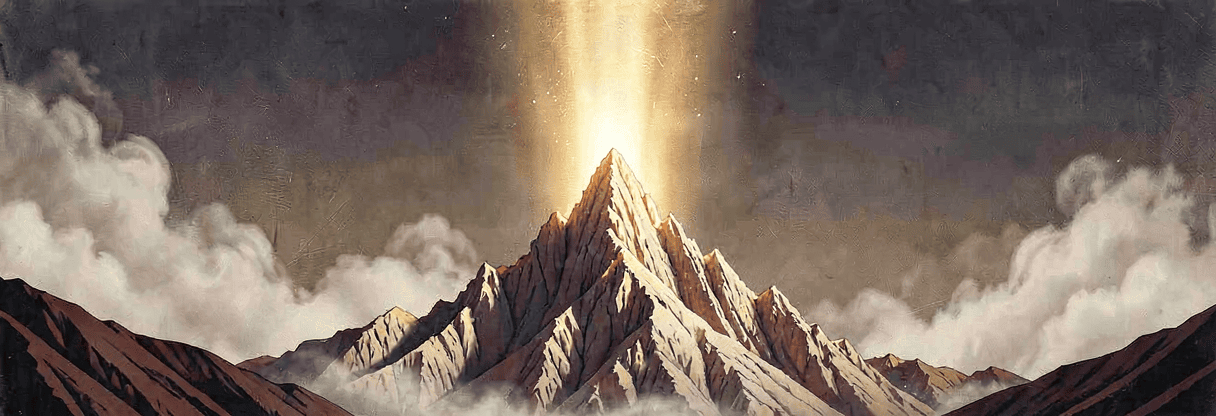
The Mountain
The high place where the air thins and the soul meets the Holy — Sinai, Olives, Hira, Meru, Tabor.
"And mount Sinai was altogether on a smoke, because the LORD descended upon it in fire..."
"I will lift up mine eyes unto the hills, from whence cometh my help."
"And after six days Jesus taketh Peter, James, and John his brother, and bringeth them up into an high mountain apart..."
"And seeing the multitudes, he went up into a mountain..."
See this theme as a comparative study.
- The Sacred Mountain
Across multiple traditions, the mountain functions as an axis mundi where the divine realm intersects with the terrestrial, serving as a locus for revelation, covenant, or theophany. While the motif of elevation facilitating access to the sacred is shared, the theological implications diverge: in Abrahamic faiths, the mountain is often the site of specific historical revelation or covenantal law, whereas in Dharmic traditions, it frequently symbolizes the cosmic order or the abode of deities rather than a singular historical event. Scholars note that the 'descent' of the divine in the Bible and Qur'an contrasts with the 'ascent' of the devotee or the identification of the deity with the mountain in Hindu texts.
- Theophany
Across these traditions, divine self-disclosure is frequently mediated through elemental phenomena such as fire, cloud, or overwhelming light, signifying a boundary between the immanent and the transcendent. While the phenomenological markers of fire and light serve as common vehicles for revelation, the theological implications diverge regarding the nature of the divine presence: whether it is localized, incarnate, or strictly ineffable. Scholars note that in Abrahamic contexts, theophany often validates prophetic authority, whereas in Hindu contexts, it frequently reveals the cosmic form of the deity to the devotee.
- The Burning Bush
This comparative motif centers on theophany through fire that defies natural combustion, marking a sacred boundary between the human and divine. In the Hebrew Bible and Christian Acts, the event reveals the divine name YHWH and commissions Moses for liberation. The Qur'anic narratives parallel this with Musa at the valley of Tuwa, emphasizing divine oneness and ritual purity through the removal of sandals. Scholars note that while the core imagery of unconsumed fire is shared, the theological framing varies between covenantal history, typological fulfillment, and prophetic selection.
- Two Mountains, Two Glories
The motif of the mountain serves as a universal liminal space where the divine intersects with the human in these three traditions. In Judaism and Islam, the peak functions primarily as a site of revelation and divine oath, often associated with law or prophetic history. Christianity reinterprets this geography through the Transfiguration, where the mountain becomes a locus of Christological fulfillment rather than legal codification. Scholars debate whether these narratives represent independent developments or a shared ancient Near Eastern heritage regarding sacred topography.
Discussion
No one has written anything here yet. Some places to begin:
- Which verse landed hardest for you?
- What's a counter-text — a verse that complicates this theme?
- How does this theme show up in a tradition not represented here?
Sign in to join the discussion.